DESIGNING RESEARCH
FOR DECISION MAKERS
Reducing the Gap Between Evidence and Action

2026
CASE STUDY
INTRODUCTION
Organizations invest enormous resources into research, analytics, and market insights. Yet history repeatedly shows that having the right information does not guarantee the right decision.
In several well-known cases, the warning signs were already present. Engineers, researchers, and analysts had identified the risks or opportunities. The problem was not the absence of information. It was how that information moved through the organization.
This case study explores a recurring challenge across industries: the gap between research and decision-making.
Through historical examples and modern organizational analysis, the project examines why credible evidence sometimes fails to influence leadership decisions and how better information design and communication strategies can help bridge that gap.
THE PROBLEM
Many organizations assume that stronger research automatically leads to better outcomes. In practice, the relationship is far more complicated.
Several factors often interfere with how information is received and acted upon:
-
Cognitive bias in leadership
-
Organizational culture that discourages dissent
-
Incentives that prioritize short-term performance
-
Complex information that is difficult to interpret quickly
When these factors combine, critical insights may be overlooked or dismissed entirely.
The result is not simply inefficient decision-making. In some cases, the consequences can be catastrophic.
HISTORICAL EXAMPLES
This pattern appears across industries and time periods.
THE CHALLENGER DISASTER
Prior to the launch of the Space Shuttle Challenger in 1986, engineers raised concerns about the performance of the O-ring seals in cold temperatures. Internal communications documented the risk, but the information was ultimately filtered through layers of organizational pressure and schedule constraints. The launch proceeded, resulting in one of the most tragic failures in the history of space exploration.
KODAK AND THE DIGITAL CAMERA
Kodak engineers developed one of the first digital camera prototypes in 1975. The technology existed within the company for decades before digital photography transformed the market. Leadership hesitation, driven by concerns about protecting the film business, delayed strategic adoption until competitors had already captured the opportunity.
NOKIA AND THE SMARTPHONE SHIFT
At the peak of its success, Nokia dominated the global mobile phone market. Internal research identified the growing importance of smartphones and software ecosystems, yet organizational dynamics and strategic hesitation slowed the company’s response to Apple and Android. Within a few years, Nokia’s market leadership collapsed.
Across these cases, the pattern is consistent. The information existed. The challenge was translating that information into decisive action.



THE FRAMEWORK: DESIGNING RESEARCH FOR DECISION-MAKERS
Across the cases examined in this study, the issue was rarely the absence of information. Engineers, analysts, and researchers often identified the risks or opportunities in advance.
The breakdown occurred when that information reached leadership.
Research that is technically accurate can still fail to influence decisions if it does not align with the way leaders evaluate risk, cost, and strategic impact.
To address this gap, this project proposes a five-part framework for structuring research so it is more likely to influence real decisions.
.
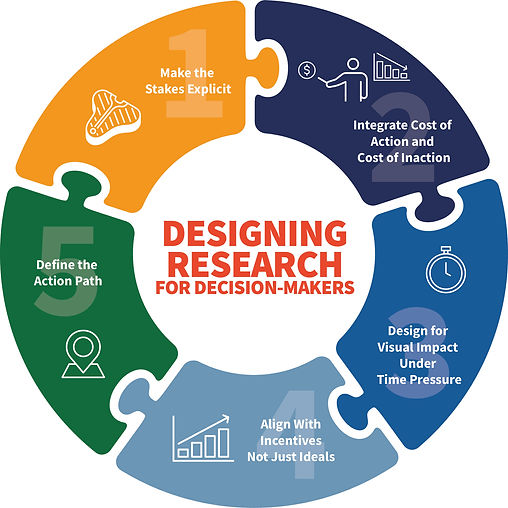
1. MAKE THE STAKES EXPLICIT
Research presentations often begin with findings. For decision-makers, consequences matter first.
Leaders need to quickly understand what is at risk: financial exposure, operational disruption, safety, or long-term competitiveness. When stakes remain abstract, urgency disappears.
Effective research communication clarifies what happens if action is taken—and what happens if nothing changes.
2. INTEGRATE COST OF ACTION AND COST OF INACTION
One common pattern across industries is that costs are separated across different reports.
Implementation expenses may be clearly documented, while the long-term cost of inaction remains diffuse or implied.
Presenting both sides together allows leaders to evaluate the true trade-off between acting now and delaying action.
3. DESIGN FOR VISUAL IMPACT UNDER TIME PRESSURE
Executives rarely read research reports line by line. Decisions are often made while scanning summaries and visuals.
Clear visual structure reduces the cognitive effort required to interpret complex information. When patterns, thresholds, or risks are visually obvious, they are much harder to ignore.
4. ALIGN WITH INCENTIVES, NOT JUST IDEALS
Research often appeals to logic and evidence. Organizational decisions are also shaped by incentives, performance metrics, and resource constraints.
Recommendations that conflict with those pressures frequently stall. Connecting research findings to the incentives leaders actually face increases the likelihood that evidence influences action.
5. DEFINE THE ACTION PATH
Many reports end with recommendations but leave the next step unclear.
Effective research communication defines a concrete path forward: what action is recommended, who owns the decision, and how progress will be measured.
When research includes a clear action pathway, it moves from documentation to decision support.
THE CORE INSIGHT
Research does not fail because the data is wrong. It fails when organizations lack effective systems for interpreting and communicating it.
Information often reaches decision-makers in formats that are too technical, too fragmented, or disconnected from the strategic context leadership needs to act.
This creates a critical opportunity for disciplines such as:
-
Information design
-
UX research
-
Strategic communication
-
Data visualization
When complex insights are translated into clear narratives and visual frameworks, leaders are more likely to understand the implications and act on them.
In other words, the effectiveness of research is often determined not only by its accuracy, but by how clearly it can influence the decision-making environment.
IMPLICATIONS FOR DESIGNERS AND STRATEGISTS
For designers, researchers, and product strategists, this insight expands the role of design beyond aesthetics or usability.
Design becomes a bridge between data and decision-making.
Effective design can help organizations:
-
Translate complex research into accessible insights
-
Highlight risks and opportunities clearly
-
Support faster and more informed leadership decisions
In this sense, the designer’s role is not only to create artifacts, but to shape how knowledge flows through an organization.
CONCLUSION
Many major organizational failures are not caused by missing information. They occur when existing knowledge fails to influence the decisions that matter.
Closing this gap requires more than collecting data. It requires designing systems that transform information into clarity, alignment, and action.
Understanding how research moves through organizations is therefore not only a technical challenge. It is a strategic one.
FULL PAPER
This case study summarizes a broader research project exploring the relationship between information design, organizational behavior, and decision-making.
The full paper is available here: